


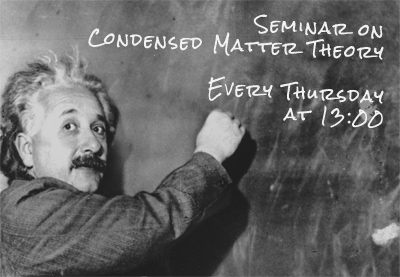
Seminar on Condensed Matter Theory
Group of Theoretical Physics at the Department of Condensed Matter Physics
of Charles University has a pleasure to invite you to attend the seminar
on 22nd October 2026 at 13:00
at Faculty of Mathematics and Physics of Charles University, Ke Karlovu 5, 121 16 Praha 2
Lecture room F2
Artur Slobodeniuk, Ph.D.
Department of Condensed Matter Physics, Charles University
Bright excitons turning to the Dark Side
Artur Slobodeniuk, Ph.D. » Bright excitons turning to the Dark Side
Department of Condensed Matter Physics, Charles University
Location: Lecture room F2, MFF UK (first floor, Ke Karlovu 5, Praha 2)
Semiconducting transition metal dichalcogenide monolayers host a rich family of excitons, which are governed by the strong spin-orbit splitting of the bands as well as the presence of a multivalley band structure. Among them, the most prominent/known are optically active 'bright' and optically inactive (spin-forbidden) 'dark' intravalley excitons. Under normal conditions, only the former type of exciton is observed experimentally. However, the application of an in-plane magnetic field mixes the bright and dark excitonic states, transferring a portion of the optical activity from bright to dark excitons [1-3]. This makes the dark excitons weakly optically active and, hence, observable in photoluminescence experiments. Since its discovery the effect of "magnetic brightening" became a powerfool tool to study dark excitonic states in transitional metal dichalcogenides and other layered systems [4 - 6] . Despite the fact that this effect of 'magnetic brightening' has been observed in many laboratories, the complementary effect of 'magnetic darkening' has not yet been reported. In this talk, we explain the reasons behind the difficulty in observing the magnetic darkening effect and propose ways to overcome these challenges to make its optical observation feasible.
References:
[1]
[2] Xiao-Xiao Zhang, Nat. Nanotech.,12, 883-888 (2017)
[3] Phys. Rev. Lett. 123, 096803 (2019)
[4] Timo Neumann et al., Nat. Commun. 12, 3489 (2021)
[5] Kaiyang Huang et al.,Phys. Rev. Lett. 137, 076903 (2026)
[6] Grzegorz Krasucki, https://arxiv.org/abs/2604.25553
If you wish to receive regular updates on fothcoming seminars, contact K. Carva.
