Advancing Quantum Photonics and 2D-Material Research
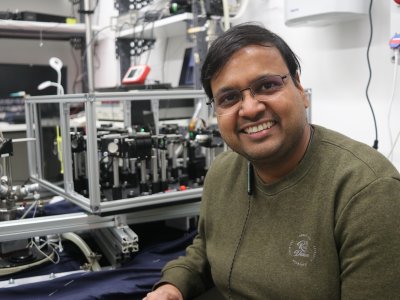
A new state-of-the-art experimental platform for generating and studying twisted light—light carrying orbital angular momentum (OAM)—has been successfully developed at the Faculty of Mathematics and Physics, Charles University (Matfyz). The system was designed and realized by Dr. Rahul Kesarwani as part of his MSCA-CZ Fellowship, under the supervision of Prof. Jana Kalbáčová Vejpravová.
This unique setup enables the precise creation, manipulation, and detection of OAM beams and integrates these capabilities with ultra-low temperatures (down to 2 K) and high magnetic fields (up to 14 T). Such conditions allow researchers to probe fundamental light–matter interactions that are inaccessible using conventional optical systems. Only a small number of laboratories worldwide operate comparable platforms combining full OAM control with cryogenic magneto-optical measurement capability.
Understanding Light–Matter Interactions Using OAM
Twisted light introduces an additional degree of freedom beyond the conventional light polarization. When interacting with 2D materials such as MoS₂, WS₂, WSe₂, or their van der Waals heterostructures, OAM can influence optical selection rules and excitonic responses. Recent experimental and theoretical works—including our own demonstration of OAM-controlled excitonic behavior—have shown that twisted light can modify exciton and trion populations, alter optical selection rules, and create new pathways for angular-momentum–dependent coupling in 2D semiconductors [1, 2].
Furthermore, several studies suggest that twisted light can also affect photocurrent generation and IV characteristics in low-dimensional materials, offering new opportunities for optoelectronic control and contributing to refinement of the overall research direction [3].
The newly built platform will allow systematic, high-precision studies of how various materials respond to structured light under extreme magnetic environments. These investigations are expected to advance quantum photonics, optical information processing, and open entirely new perspectives in light–matter interactions within low-dimensional and quantum materials.
Strengthening Matfyz Research Infrastructure
The successful development of this unique experimental setup significantly strengthens the research capabilities of the department. It will support future collaborations, stimulate high-impact joint publications, and enhance student training within both Czech and international research networks.
We express our sincere thanks to all colleagues, technical teams, and collaborators whose direct and indirect contributions were crucial to the construction, optimization, and integration of the system. We also gratefully acknowledge Prof. Martin Kalbáč from the Heyrovský Institute for his valuable scientific discussions and suggestions, which contributed to the refinement of the research direction. This work has been supported through the Marie Skłodowska-Curie Actions (MSCA-CZ) Fellowship of Dr. Rahul Kesarwani, which promotes international scientific excellence and researcher mobility at Charles University. The establishment of this facility not only advances our current research direction but also lays a strong foundation for future innovation in optical and materials science at the faculty.
References:
[1] R. Kesarwani et. al., Sci. Adv. 8, 1-8, (2022).
[2] O.J.G. Sanchez, et. al., ACS Nano, 18, 11425−11437 (2024).
[3] Y.-J Feng, et. al., ACS Nano, 16, 9297−9303 (2022).